History of Georgian Winemaking
Located in the South Caucasus region, at the crossroads of Western Asia and Eastern Europe, Georgia boasts an ancient winemaking history, a large assortment of indigenous grape varieties and some traditional winemaking methods that have recently been rediscovered and are attracting the attention of critics and consumers from all over the world. Between tradition and modernity, this land of contrasts, rich in an eventful history, is considered the cradle of viticulture and the country with the longest unbroken tradition of winemaking in the world!
Archaeologists agree: wine was born here. There are evident traces of pressed and fermented grapes that date back to 8,000 years ago. And this is the place where some of the most peculiar aging techniques have been practiced for centuries, including the Qvevri method.

This country has been a coveted gateway for thousands of years. Its location on the Silk Road has brought it wealth, but too many wars have left indelible traces. Repeatedly devastated by ancient or recent invaders from various directions, none of whom have really managed to scratch their soul, Georgia has always stood out for its marked national pride. A legend tells of how Georgian soldiers kept a vine branch inside their armor, so if they died in battle, a vine would sprout from their hearts. And also the colossal statue Kartlis Deda, or Mother Georgia, which dominates the capital Tbilisi from above, holds a sword in one hand and a cup of wine in the other, symbols of a courageous and warm people.
The development of the vineyard was obviously marked by historical events, but the Georgians have always continued to make wine. Historically, families have always produced wine from small plots of land. Important companies belonged to royal families, such as Château Mukhrani, the only winery in the country, owned by Prince Mukhranbatoni in the 19th century, before being expropriated following the establishment of the Soviet regime in 1921.
During this period, much of the Georgian vineyard was uprooted to make way for the most productive international grape varieties to supply the USSR, with the risk of losing the country's biodiversity heritage. The wines produced were of low quality, victims of their high yields and their mass production.
After the independence from the Soviet Union, over the past 20 years, some winemakers have worked hard for a return to traditional Georgian wine. They recovered old vineyards, pursued the use of the underground amphora, and revived the long macerations, starting a true Renaissance of wine for this country.
Top Award-Winning Georgian Wines
Although the volume of wine production is limited, especially compared to large European producers, Georgian wines are starting to be exported all over the world. The major newspapers are constantly writing about them, as well as specialized websites and magazines. The attention of the critics and the promotional activity carried out by the National Wine Agency of Georgia have allowed the international public to know and appreciate these little jewels.

Today these wines are not only purchasable online but are awarded in international competitions and are present in the wine lists of some of the best restaurants in Europe, including Michelin-starred ones, a clear sign of the interest that is growing both from critics and consumers.
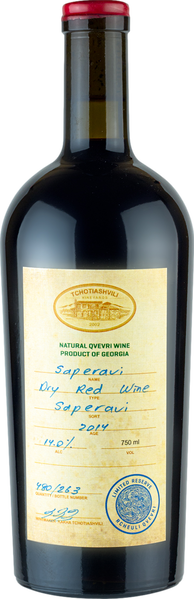
One of the most authoritative standard bearers of Georgian wine, what local producers like to call authentic natural wine, is the Tchotiashvili winery, widely recognized for its high quality amphora wines. As for the vast majority of Georgian wineries, this is also a family-run business where know-how is handed down from father to son. This passion is clearly tangible in their wines.