La Rioja Alta is a pearl within an oyster: one of the most venerated wineries in the world, situated in one of the world’s greatest winemaking regions. It was founded in 1890 in Haro, La Rioja, Spain. This was just 2 years before the “Viticulture and Enology Station of Haro” was established, one of the first bodies for protecting the quality of Rioja wine. That is to say, the La Rioja Alta winery and top-quality traditional Rioja wine go hand-in-hand, and have done so since about the 19th century.
La Rioja Alta is also one of the best names to look out for in terms of value. It is one of our favourite wineries, striking an ideal balance between price point and critical acclaim. In this article, we will give you a thorough introduction to the winery, and some of its most delicious wines.
A Brief History of La Rioja Alta Winery

There’s nothing better than stories about people coming together for a greater cause – this is exactly what happened during La Rioja Alta’s foundation in 1890. This winery is the result of five local growers coming together, a mixture of Basque and Riojan families. Out of these five growing families, Doña Saturnina García Cid y Gárate was appointed as president, and she chose a Frenchman to take control of the winemaking itself, Albert Vigier.
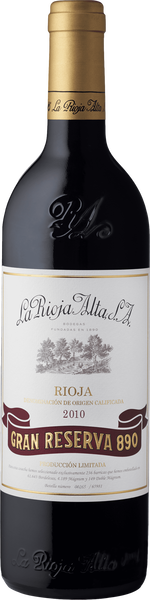
Vigier’s first cuvee, Reserva 890, was the predecessor to the modern-day Gran Reserva 890, a distinct, traditional Rioja red with a strong tannic Tempranillo core that brilliantly reflects over a century of winemaking.
In 1904, La Rioja Alta reached its second landmark event, when it merged with Ardanza Winery, an estate owned by one of the five original families. This can be considered the birth of La Rioja Alta, as we know it today. To commemorate the event, the winery created Reserva 904, continued in the modern form of Gran Reserva 904.
Over the next century, La Rioja Alta continued to expand, planting vines in Galicia, and nurturing the incredible reputation that they have today, through a range of wines that balances modernity and tradition. The winery celebrated its 100th birthday with the acquisition of Áster, a new branch of the winery in Ribera del Duero. Today, most of the winemaking decisions are made by Head Winemaker Julio Sáenz.
Terroir and Tradition: La Rioja Alta’s Vineyards

La Rioja Alta’s vineyards cover over 700 hectares of land. Most of them are inside of Rioja, in Rioja Alta and Rioja Alavesa, but some can also be found outside, in locations like Ribera del Duero (slightly further to the south) and Galicia (skirting the Atlantic Ocean). Their vineyards cover diverse tracts of land, touching both Mediterranean and more maritime climates.
For that very reason, it is difficult to give an exact name to what makes La Rioja Alta wines so special. The winery’s careful selection and blending of vineyards certainly helps.
For the Gran Reserva 904, for example, the fruits are sourced from a selection of vineyards in Brinas, Rodezno, Fuenmayor, and Villalba. For 890, the fruits are sourced from more high-altitude vineyards, in Montecillo, Labastida, and Brinas. The vines themselves are particularly important, as many of those chosen for 904 are old, gnarled specimens, between 22 and 70 years old, and strike a balance between limited but healthy yields.
The specific grape clones in the vineyards are a mystery even unto the winemakers, but the folks at La Rioja Alta primarily harvest traditional Spanish varietals, like Tempranillo, Graciano, and Mazuelo. In a further act of commitment towards expressing the pure terroir of Rioja, all of the harvesting at La Rioja Alta is conducted by hand. It takes around 150 people in all, who spend 4 weeks combing the green hillsides for the ripest fruits.
Sustainability is a large part of what La Rioja Alta does, and there has been a huge drive towards organic viticulture in recent years, under Julio Sáenz. Over 16 hectares of their active vineyards are now 100% organic. Additionally, those at the winery have set up a solar farm at their Labastida site, which offsets 41.57 tonnes of CO2 emissions every year.
Creative Control: La Rioja Alta’s Winemaking Techniques
Due to the country’s colonial past in the Americas, Spanish wineries have long used American oak barrels, rather than French or Slavonian. However, since 2001, as many Rioja wineries move away from using American oak, La Rioja Alta has stuck to tradition, while approaching it from a slightly different angle. Rather than importing American barrels ready-made, they import oak planks, and construct their own barrels in the winery.
This method allows the winery to exercise greater creative control over the oaking process. Before 2001, the average age of La Rioja’s barrels was about 19 years, while today, it is about 4.5, allowing for much greater hygiene and more consistent quality.
Creating the barrels in-house also allows for tighter control over yeast and bacteria, preserving the wine’s quality. In the modern winery, fill levels are watched closely to avoid any oxidation or bacterial growth, and the planks are rigorously cleaned with hot water and steam before being crafted into barrels. Through innovation, La Rioja Alta have succeeded in bringing modern standards and a desirable freshness to their wines, while maintaining a fiercely traditional approach to winemaking.
Signature Wines

There are three great wines that form the backbone of La Rioja Alta’s reputation. The aforementioned historical Gran Reserva wines, and an extremely popular Reserva named Viña Ardanza. Along with their third Gran Reserva wine, Viña Arana, La Rioja Alta became the first winery in the region to offer three different Gran Reserva wines, wines that have spent at least 2 years in the barrel and 3 years in the bottle.
Let’s take a look at the foundational wine for La Rioja Alta, Gran Reserva 890.